Azure Purview Catalog client library for Python — Azure SDK for Python 2.0.0 documentation

David Craig
Published Feb 16, 2026
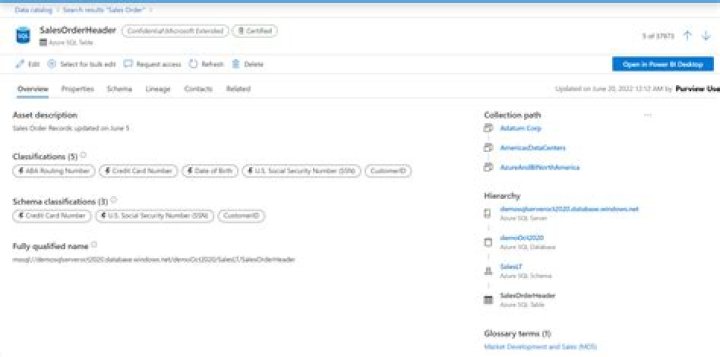
Azure Purview Catalog is a fully managed cloud service whose users can discover the data sources they need and understand the data sources they find. At the same time, Data Catalog helps organizations get more value from their existing investments.
Search for data using technical or business terms
Browse associated technical, business, semantic, and operational metadata
Identify the sensitivity level of data.
Please rely heavily on the `service’s documentation < and our `client docs < to use this library
Source code | Package (PyPI) | API reference documentation| Product documentation
Disclaimer
Azure SDK Python packages support for Python 2.7 is ending 01 January 2022. For more information and questions, please refer to
Getting started
Prerequisites
Python 2.7, or 3.6 or later is required to use this package.
You must have an Azure subscription and a Purview to use this package.
Create a Purview Resource
Follow these instructions to create your Purview resource
Install the package
Install the Azure Purview Catalog client library for Python with pip:
pip install azure-purview-catalog
Authenticate the client
To use an Azure Active Directory (AAD) token credential, provide an instance of the desired credential type obtained from theazure-identity library.
To authenticate with AAD, you must first pip install ``azure-identity` <>`_ andenable AAD authentication on your Purview resource
After setup, you can choose which type of credential from azure.identity to use. As an example, DefaultAzureCredentialcan be used to authenticate the client:
Set the values of the client ID, tenant ID, and client secret of the AAD application as environment variables: AZURE_CLIENT_ID, AZURE_TENANT_ID, AZURE_CLIENT_SECRET
Use the returned token credential to authenticate the client:
from azure.purview.catalog import PurviewCatalogClientfrom azure.identity import DefaultAzureCredentialcredential = DefaultAzureCredential()client = PurviewCatalogClient(endpoint="", credential=credential)
Key concepts
Client
This package offers request builders so you can build http requests and send these requests to the service using the send_request method.
For more information on how to use request builders and our clients, see here.
Examples
The following section shows you how to initialize and authenticate your client, then get all of your type-defs.
Get All Type Definitions
from azure.purview.catalog import PurviewCatalogClientfrom azure.identity import DefaultAzureCredentialfrom azure.core.exceptions import HttpResponseErrorcredential = DefaultAzureCredential()client = PurviewCatalogClient(endpoint="", credential=credential)try: response = client.types.get_all_type_definitions() # print out all of your entity definitions print(response['entityDefs'])except HttpResponseError as e: print(e)
Troubleshooting
General
The Purview Catalog client will raise exceptions defined in [Azure Core][azure_core] if you call .raise_for_status() on your responses.
Logging
This library uses the standardlogging library for logging. Basic information about HTTP sessions (URLs, headers, etc.) is logged at INFO level.
Detailed DEBUG level logging, including request/response bodies and unredacted
headers, can be enabled on a client with the logging_enable keyword argument:
import sysimport loggingfrom azure.identity import DefaultAzureCredentialfrom azure.purview.catalog import PurviewCatalogClient# Create a logger for the 'azure' SDKlogger = logging.getLogger('azure')logger.setLevel(logging.DEBUG)# Configure a console outputhandler = logging.StreamHandler(stream=sys.stdout)logger.addHandler(handler)endpoint = ""credential = DefaultAzureCredential()# This client will log detailed information about its HTTP sessions, at DEBUG levelclient = PurviewCatalogClient(endpoint=endpoint, credential=credential, logging_enable=True)
Similarly, logging_enable can enable detailed logging for a single send_request call,
even when it isn’t enabled for the client:
result = client.types.get_all_type_definitions(logging_enable=True)
Contributing
This project welcomes contributions and suggestions. Most contributions require you to agree to a Contributor License Agreement (CLA) declaring that you have the right to, and actually do, grant us the rights to use your contribution. For details, visit cla.microsoft.com.
When you submit a pull request, a CLA-bot will automatically determine whether you need to provide a CLA and decorate the PR appropriately (e.g., label, comment). Simply follow the instructions provided by the bot. You will only need to do this once across all repos using our CLA.
This project has adopted the Microsoft Open Source Code of Conduct. For more information see the Code of Conduct FAQ or contact opencode@microsoft.com with any additional questions or comments.
Indices and tables
Developer Documentation